|
|
|
ChemBioNexus |
|
ISSN: 2024-2025 ISSN: 2024-2026
|
Hafiza Asma Naurin*, Sheema Yousaf
Department of Biology, Faculty of Basic Sciences, Lahore Garrison University, Lahore
|
*Correspondence Email: asmanurain869@gmail.com DOI: Received: 10th January, 2025 Revised: 12th March, 2025 Accepted: 6th April, 2025
|
|
Abstract Environmental pollution with heavy metals is a major disaster for this planet earth and with each passing day, this problem is aggravating. The main purpose of this research was to check the chromium reduction ability of indigenous bacteria in their biofilm and planktonic modes of life. For this purpose, Chromium (Cr) resistant bacteria were isolated from soil and wastewater samples collected from tanneries and wastewater treatment plants in Kasur, Punjab, Pakistan. The selected bacterial isolates were checked for their biofilm forming ability both quantitatively and qualitatively in the absence and presence of Cr stress. Minimum inhibitory concentration (MIC) for the Cr was found to be varied for bacterial isolates. On the basis of MIC and biofilm forming ability, four bacterial isolates AN1, AN2, AN4 and AN5 were selected for further studies. These bacterial isolates were characterized morphologically, physiologically and biochemically. Optimum pH and temperature were found to be 7 and 37ºC respectively. Based on biochemical characteristics, these bacterial isolates were found to be the members of three different genera, i.e., AN1 and AN4 belonged to Bacillus, AN2 belonged to Pseudomonas and AN5 belonged to Salmonella. Cr reduction ability of bacterial isolates was checked with Diphenyl carbazide method. Overall, the bacterial isolates showed increased Cr reduction after 48 hours. In biofilm mode of growth, bacterial isolates AN1 and AN4 showed more chromium reduction as compared to their planktonic cells whereas in planktonic cells mode, AN2 and AN5 showed more chromium reduction as compared to their biofilm mode of growth. |
|
Keywords: Chromium reduction Biofilms Planktonic cells Biochemical characterization Diphenyl carbazide |
Introduction
The word “bioremediation” is made up of two words: “bio which means “biological,” and “remediation” which means “to remedy”. It is a procedure that uses microbes or their enzymes to eliminate pollutants from a contaminated environment. Microorganisms such as bacteria and fungi, are primarily utilized in the bioremediation process to clean out contaminated soil and water [1]. It refers to a verity of methods and practices that utilize natural arrangements and procedures to get rid of the contaminants from contaminated environments [2]. Pollution of the environment is one of the most significant issues confronting life on our planet today. When the ecosystem is unable to process and neutralize damages by product of human activity, pollution occurs. On Earth, there are three types of pollution: water pollution, soil pollution and air pollution.
Heavy metals are the contaminants or pollutants of the environment and their excessive amount causes air, water and soil pollution. Heavy metals are those that have density above than 5g/cm3 [3]. These are naturally occurring elements and are present in earth’s crust. The amount of heavy metals is increasing day by day because of anthropogenic activities such as smelting operations, mining, industrial production, metal refineries etc. These heavy metals are non-degradable so, once they are released in the environment they remain in the environment unless or until they are removed by proper mechanisms. These heavy metals include chromium, lead, mercury, arsenic, cadmium, copper, selenium, zinc etc. The elevated levels of heavy metals are hazardous for life [4]. These heavy metals can cause damage to various organelles of the body including mitochondria, lysozyme, cell membrane, nucleus, endoplasmic reticulum and some essential enzymes that are involved in repair, detoxification mechanisms and metabolism. It can also cause damage to the DNA and lead to mutagenesis, carcinogenesis or apoptosis by the interaction of metal ions with the cellular components [5].
Cr, a transition metal, is of great concern due to its highly toxic nature. It is released into the environment as a byproduct of sectors such as metallurgical, textiles and ceramics, leather, tanning, metal finishing, pigment photographic sensitizer and wood preservatives manufacturing etc. [4, 6]. There are different chemical species of chromium but it is mostly present in trivalent form which is less toxic and hexavalent form which is more toxic. Its fast permeability across organic membrane and consequent interface with nucleic acid and intracellular proteins appears and very hazardous heavy metal called Cr+6 is released into the environment, using water pollution [7]. Hexavalent Chromium (Cr+6) is 100–1000 times more deadly then trivalent (Cr+3) [8].
As a result, one of the important methods for chromium detoxification by microbes is the conversion of Cr+6 to Cr+3 [9]. Chemical reduction is followed by procedures such as ion exchange absorption and precipitation on coal, alum, kaolinite, activated carbon and flash to detoxify and eliminate Cr+6 from the environment. Most of bacteria have been observed to decrease Cr+6 to Cr+3 over time in aerobic, anaerobic, or both environments [8].
Microbes particularly bacteria exist in two forms of life such as biofilms and planktonic cells. The bacteria which are exists in the form of surface-attached communities are known as biofilms. The metabolism of biofilm cells totally differ from the planktonic cells [10]. A biofilm is a numbers of microorganisms comprising of microbial species attached to a biological or inert surface and encased in a self-synthesized matrix comprising of carbohydrates, water, extracellular DNA proteins, and [11]. Biofilm mediated remediation is cost effective and environment friendly and better option for removal of environmental pollutants [12].Use of biofilms is productive for immobilize, bioremediation as biofilms absorb and degrade a variety of environmental pollutants [13].
The main objective of this research project was to isolate, characterize and study the chromium reduction potential of chromium resistant bacteria. These bacteria were isolated from industrial effluents and soil samples, and their chromium reduction potential was studied both in planktonic and biofilm modes of growth.
Materials and Methods
Isolation of Cr resistant bacteria
Cr resistant bacteria were isolated from wastewater and soil samples collected from tannery industries and wastewater treatment plant of Kasur, Punjab, on K2Cr2O7 supplemented nutrient agar plates. These plates were incubated at 37ºC for 24 hours. The selected bacterial isolates were purified by several rounds of quadrant streaking on the same Cr supplemented nutrient agar plates.
Morphological characterization of bacterial isolates
For the study of colony morphology, single colonies of each bacterial isolate were obtained and studied for various characteristics like size, color, elevation, shape, margins of the colonies. For the observation of shape and arrangement of the cells, gram staining was performed on 24 hours old incubated bacterial cultures following the method described in [14].
Determination of Biofilm formation of bacterial cells
Qualitative analysis of biofilm formation of bacterial cells
A qualitative assay for biofilm development of bacterial cells was performed by using the protocol previously described [15]. Briefly, bacterial cultures were grown by inoculating the 100μl overnight culture (OD600nm= 0.1) in two types of media, the first set of test tubes contained 10ml N-broth with 100 μg/ml K2Cr2O7 stress and the second set of test tubes contained N-broth without K2Cr2O7 . Each set included a negative control (media without inoculation). Without agitation, these tubes were incubated at 37°C for 72 hours. The liquid medium was removed after 72 hours, and the bacterial biofilm was observed by staining test tubes with a 0.1% aqueous crystal violet solution for 20 minutes at the room temperature. Tubes were washed with distilled water to remove the excess pigment. The tubes were air dried upturned and examined for biofilm development.
Quantitative analysis of biofilm formation of bacterial cells
Quantitative analysis for bacterial cell’s biofilm development was performed by following the procedure described [16]. Quantitative analysis of biofilm for the bacterial isolates was performed on pre-sterilized 96 well flat bottom polystyrene micro-titer plates in triplicates. An inoculum of 20 μl of to each bacterial isolate (OD600nm= 0.1) was added in the wells of micro-titer plates. Eight wells were selected for each bacterial isolate in microtiter plate, 4 wells with 100 μg/ml K2Cr2O7 supplemented media and 4 wells without K2Cr2O7 supplemented media. Each well contained 180 μl of N-broth, as the total capacity of each well was 200 μl. Negative controls containing only the medium were also set in microtiter plate. The microtiter plates were closed, sealed, and incubated at 37°C for 72 hours. After incubation, the visual density was then measured with ELISA plate reader at 600 nm. Bacteria were stained with 0.1% solution of crystal violet (100 µl each well) for 20 minutes; then rinsed one time with distilled water. After that 33% glacial acetic acid was added in the wells and mixed well with the biofilm present in the wells. The optical density was then measured with ELISA plate reader at 570 nm.
Determination of minimum inhibitory concentration (MIC) for chromium
A broth dilution process was used to check the MIC of chromium for the bacterial isolates following the protocol given by [17]. N-broth was prepared in test tubes (10 ml media per tube) and the tubes were added with dissimilar concentration of Cr ranging from 100 μg/ml to 1000 μg/ml with an interval of 50 μg/ml in between each concentration. An inoculum of 100 μl of overnight bacterial cultures (OD600nm= 0.1) was added in K2Cr2O7 supplemented media test tube. One negative control was used for each concentration of Cr. This experiment was performed in triplicates. Tubes were incubated for 24 hours at 37oC at shaking incubator. The MIC was established as the lowest chromium concentration at which the microorganism showed no observable growth.
Physiological characterization of Cr resistant bacteria
Optimum pH and temperature for the growth of selected bacterial isolates was determined by following the protocol described by [18].
Biochemical characterization of Chromium resistant bacteria
The bacterial isolates were characterized biochemically by following the protocols as previously described [14].
Chromium reduction by bacterial isolates in planktonic cells
To check the potential of bacterial isolates in planktonic form to reduce hexavalent chromium, experiment was done following the protocol as previously described by [19]. N-broth was prepared, dispensed in 5 separate flasks (250ml media per flask) and autoclaved. A 1% inoculum of overnight bacterial cultures (OD600nm= 0.1) was added in their respective flasks for microbial isolates. The flasks remained incubated on shaker at 37℃ for different time intervals (24 and 48 hours). After the completion of incubation periods of 24 and 48 hours, 15 ml of bacterial cultures were dispensed in separate falcons aseptically and centrifuged at 4000 rpm for 10 minutes. The residual Cr+6 concentration was determined from supernatants via diphenyl carbazide method as previously described by [20].
Chromium reduction by the biofilms of bacterial isolates
This experiment was performed to check the potential of bacterial isolates for Cr reduction in biofilm mode. N-broth was prepared, dispensed in 5 separate flasks (250ml), glass slides were kept in the flasks and autoclaved. A 1% inoculum of standardized overnight bacterial cultures (OD600nm= 0.1) was added in the respective flasks designated for each bacterial isolate. The flasks were incubated on static condition at 37℃ for 72 hours for the formation of biofilms on glass slides. N-broth was prepared, dispensed in 5 separate flasks (250ml) and autoclaved. Added 100 µg/ml stress of chromium. All these flasks were then inoculated with biofilms (on glass slides) with their respective designated bacterial isolates and incubated on static condition at 37℃ for 24 and 48 hours. After the completion of incubation period of 24 and 48 hours, the residual Cr+6 concentration was determined from supernatants via diphenyl carbazide method as previously described by [20].
Statistical analysis
All the tests have been done in duplicates/triplicates. Mean values were determined for the plotting of graphs and standard deviation of the duplicates/triplicates values has been represented with error bars in graphs. These error bars were put using Microsoft Excel 2013.
Results
Isolation of chromium resistant bacteria
Total of eight bacterial isolates that showed resistance against chromium were selected on the basis of difference in the morphology of bacterial colonies. Out of these bacterial isolates, four were from wastewater samples and four were from soil samples. These selected bacterial isolates were further purified (Table 1).
Morphological characterization of bacterial isolates
The morphological characteristics of the bacterial isolates have been given in table 2 below.
Table 1: Number and codes for the selected bacterial isolates
|
Samples |
Isolates selected |
Codes for the bacterial isolates |
|
Soil from tannery industry |
04 |
AN1, AN2,AN3 and AN4 |
|
Wastewater sample from Wastewater treatment plant, Kasur |
04 |
AN5, AN6,AN7 and AN8 |
Table 2: Morphological characteristics of chromium resistant bacterial isolates
|
Characteristics |
AN1 |
AN2 |
AN3 |
AN4 |
AN5 |
AN6 |
AN7 |
AN8 |
|
Shape |
Circular |
Irregular |
Irregular |
Circular |
Circular |
Circular |
Irregular |
Circular |
|
Elevation |
Raised |
Convex |
Flat |
Raised |
Convex |
Raised |
Raised |
Raised |
|
Pigmentation |
White |
Greenish |
Creamy |
White |
White |
Orange |
Creamy |
White |
|
Texture |
Rough |
Smooth |
Smooth |
Rough |
Smooth |
Rough |
Rough |
Smooth |
|
Margin |
Undulate |
Undulate |
Lobate |
Undulate |
Entire |
Undulate |
Lobate |
Sharply |
|
Size |
Large |
Medium |
Small |
Large |
Large |
Small |
Small |
Pinpoint |
|
Appearance |
Dry |
Mucoid |
Mucoid |
Dry |
Mucoid |
Mucoid |
Mucoid |
Dry |
|
Gram’s staining |
Positive |
Negative |
Positive |
Positive |
Negative |
Positive |
Positive |
Negative |
Determination of Biofilm formation ability of bacterial isolates
Qualitative analysis of biofilm formation
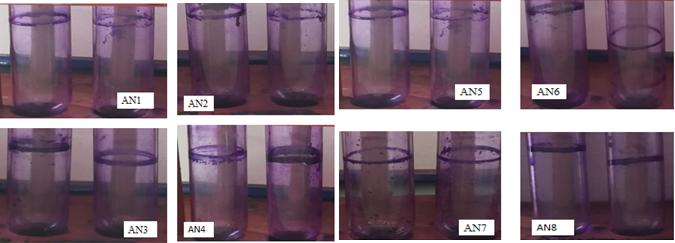
Biofilm forming capability of the bacterial isolates was accessed qualitatively by ring test, both with and without chromium stress. All these bacterial isolates were found to be biofilm formers but having variable abilities of biofilm formation. Some bacterial isolates were good biofilm formers bacteria and some were weak biofilm formers. Biofilm formation was recognized as dark purple ring on the surface of test tube (Figure 1).
|
Figure1: Qualitative analysis of biofilm formation of Cr resistant bacterial isolates by ring test assay
|
Quantitative analysis of biofilm formation
Ability of Biofilm formation, the chromium resistant bacterial isolates was studied quantitatively and the results of this assay were found to be compatible with qualitative assay. The result of qualitative analysis of biofilm formation of bacterial cells, all these bacteria are biofilm formation some bacterial strains were good biofilm forming bacteria and some were not good biofilm forming bacteria (Figure 2).
|
Figure 2: Quantitative assay for biofilm forming ability of chromium resistant bacterial isolates |
Minimum Inhibitory Concentration (MIC) of chromium for the bacterial isolates
MIC values of chromium have been shown in Figure 3. MIC of bacterial isolate showed dissimilar values for each bacterial isolate. The microbial isolate AN5 showed maximum value of MIC i.e., 950 µg/ml. The bacterial isolates AN3 and AN7 showed the minimum values for MIC of Cr i.e., 450 µg/ml. The MIC values for the bacterial isolates, AN1, AN2, AN4, AN6 and AN8 were found to be 600, 550, 750, 500, 500 µg/ml respectively (Figure 3). Based on the biofilm forming ability and MIC, four bacterial isolates (AN1, AN2, AN4 and AN5) were selected for further studies.
Physiological characterization of Cr resistant bacteria
All of the bacterial isolates showed highest growth at the pH 7 and 37oC, so it was considered as optimum pH and temperature for the growth of bacterial isolates (Figure 4A and 4B).
|
Figure 3: Minimum inhibitory concentrations of bacterial isolates |
|
Figure 4: Effect of pH (A) and Temperature (B) on bacterial growth |
Biochemical characterization of bacterial isolates
The results for biochemical characterization of bacterial isolates have been shown in Table 3.
Identification of bacterial isolates on the basis of biochemical characterization
On the basis of biochemical characterization, the bacterial isolates AN1 and AN4 belonged to genus Bacillus and AN2 belonged to the genus Pseudomonas AN5 belonged to genus Salmonella.
Table 3: Biochemical characterization of bacterial isolates
|
Biochemical tests |
Bacterial isolates |
|||
|
AN1 |
AN2 |
AN4 |
AN5 |
|
|
Catalase |
P |
P |
P |
P |
|
Oxidase |
N |
P |
N |
N |
|
Indole |
N |
N |
N |
N |
|
Methyl red Test |
N |
N |
N |
P |
|
Voges Proskauer(VP) Test |
P |
P |
P |
N |
|
Citrate Utilization Test |
P |
P |
P |
N |
P = positive and N = negative
Chromium reduction by bacterial isolates in planktonic and biofilm modes of growth
Reduction potential of bacterial isolates was determined both in planktonic and biofilm modes of growth after 24 and 48 hours of incubation by Diphenyl carbazide method. According to the results bacterial isolates AN1, AN2, AN4 and AN5 reduced Cr+6 64.99 µg/ml, 80.142µg/ml, 55.14 µg/ml and 76.28µg/ml respectively in planktonic cells after 24 hours. The bacterial isolates AN1, AN2, AN4 and AN5 reduced Cr+6 67.71µg/ml, 83.42µg/ml, 58.85µg/ml and 80.44 µg/ml respectively in planktonic cells after 48 hours. According to the results bacterial isolates AN1, AN2, AN4 and AN5 reduced Cr+6 82.28µg/ml, 47.21µg/ml, 80.14µg/ml and 54.71µg/ml respectively in biofilm mode of growth after 24 hours. The bacterial isolates AN1, AN2, AN4 and AN5 reduced Cr+6 86.42µg/ml, 50.71µg/ml, 82.49µg/ml and 58.19µg/ml respectively in biofilm mode of growth after 48 hours (Figure 5).
|
Figure 5: Chromium reduction by bacterial isolates in planktonic and biofilm modes of growth |
DISCUSSION
Heavy metals contamination is a major problem all around the world including Pakistan. Increased industrialization contributes to the high levels of heavy metal pollution in Pakistan. One of the main environmental pollutants is Cr in Pakistan. It is found in ground water, soil water, as well as in surface because of its use in the tanneries. Among all the methods available, bioremediation is an ecofriendly method to detoxify this heavy metal from the environment. In this study, Cr resistant bacteria were isolated from wastewater and soil samples collected from tannery industries and wastewater treatment plant, Kasur, Punjab. A total of eight bacteria were selected from these two types of samples, four bacterial isolates (AN1, AN2, AN3 and AN4) were selected from wastewater and four bacterial isolates (AN5, AN6, AN7 and AN7) were selected from soil sample. The selected bacterial isolates were then subjected to morphological characterization which included colony and cell morphology. Gram’s staining revealed that bacterial isolates AN1, AN3, AN4, AN6, and AN7 were gram positive, while AN3 AN5 and AN8 were gram negative.
The capability of chromium resistant bacterial isolates to form biofilms was investigated using qualitative and quantitative assays, and the results were found to be consistent with each other. According to the findings of qualitative and quantitative assays for biofilm production by these isolated chromium resistant bacteria, all of these bacteria formed biofilms but with varying abilities both with and without chromium stress. Some bacterial isolates were good biofilm formers, whereas others were not. Some bacterial isolates like AN1, AN5, AN3 and AN7 formed good biofilm without supplemented chromium in the culture medium, while others like AN2, AN4, AN6 and AN8 formed thin biofilms without supplemented chromium. AN4 and AN8 bacterial isolates formed good biofilms with supplemented chromium. AN1, AN2, AN3, AN5, AN6 and AN7 formed thin biofilms with supplemented chromium. Chromium is one of the most hazardous heavy metals out into the environment by a variety of industrial wastewaters, including leather tanning, electroplating, paints, pigment synthesis, and steel production [21]. Other industrial operations that use catalysts release massive amounts of chromium into the environment every year, posing a major health risk [4]. Chromium contents in the effluents released by these industries range from 10 to 100 of mg/l per [22]. MIC of the bacterial isolates AN1, AN2, AN3, AN4, AN5, AN6, AN7, and AN8 had varied values. The bacterial isolate AN5 has the highest MIC value equal to 950 µg/ml. The bacterial isolates AN3 and AN7 had the lowest MIC of Cr, which was 450 µg/ml for both. The MIC values for the bacterial isolates AN1, AN2, AN4, AN6, and AN8 were 600, 550, 750, 450, 500 µg/ml. The bacterial species having the ability to resist chromium at different concentrations have been isolated by other researchers as well. Researchers isolated two chromium resistant bacteria Pseudomonas sp. and Acinetobacter sp. they showed MIC 160 mg/l and 200 mg/l respectively [23]. Other researchers isolated chromium resistant bacteria Azotobacter sp., Bacillus subtilis, and Pseudomonas putida and they showed MIC equal to 50, 100, and 500 mg/L respectively, similarly, Pseudomonas aeruginosa and Serratia marcescens showed MICs of 200 and 150 mg/L respectively [24]. Four bacterial isolates (AN1, AN2, AN4, and AN5) were selected for further experiments to check their potential for chromium reduction both in biofilm mode of growth and planktonic form. The selection was based on their biofilm forming capacity and MIC values. These selected bacterial isolates were then characterized physiologically and biochemically. The optimum pH and temperature were found to be 7 and 37ºC respectively. On the basis of biochemical characteristics, these bacterial isolates were found to be the members of three genera, i.e., AN1 and AN4 belonged to Bacillus, AN2 belonged to Pseudomonas and AN5 belonged to Salmonella.
The Diphenyl carbazide technique was used to measure the chromium reduction potential of bacterial isolates in planktonic and biofilm modes of growth after 24 and 48 hours of incubation. After 24 hours, bacterial isolates AN1, AN2, AN4, and AN5 reduced Cr+6 to Cr+3 equal to 64.99 %, 80.142 %, 55.14 % and 76.28 % respectively, in their planktonic mode of growth. After 48 hours, the same bacterial isolates (AN1, AN2, AN4, and AN5) reduced Cr+6 to Cr+3 equal to 67.71 %, 83.42 %, 58.85 % and 80.44 % respectively, in planktonic form of growth. Bacterial isolates showed more Cr+6 reductions after 48 hours as compared to 24 hours in planktonic mode of growth. Such type of study has also been conducted by some other researchers, who used two gram positive Cr+6 resistant bacterial strains Bacillus aerius (98%), Brevibacterium iodinum (99%), Rhodobactersedminis (66%) and P. entomophila (80%) under hexavalent chromium stress and the strains showed chromium reduction (Cr+6 to Cr+3) in planktonic mode of growth [19, 25, 26].
After 24 hours, bacterial isolates AN1, AN2, AN4, and AN5 reduced Cr+6 in biofilm cells by 82.28 %, 47.21 %, 80.14% and 54.71% respectively. After 48 hours, bacterial isolates AN1, AN2, AN4, and AN5 reduced Cr+6 by 86.42 %, 50.71%, 82.49 % and 58.19 % respectively. Bacterial isolates showed more Cr+6 reductions after 48 hours as compared to 24 hours in biofilm mode of growth. A group of researchers checked the heavy metal tolerance and exclusion effectiveness of the Rhodotorula mucilaginosa and Saccharomyces boulardii planktonic cells and biofilm. As a result, the R. mucilaginosa biofilm presented higher competence in metals eliminating associated to the planktonic cells while S. boulardii did not show capacity of biofilm formation [27]. As a result, metal removal efficiency of mixed species biofilm is greater than the single-species biofilms. The range of metal removal efficiency of single species biofilms is 81.56% to 97.85 % and in mixed species biofilms is 94.99 % to 99.88 %. Bacterial isolates AN1 (Bacillus) and AN4 (Bacillus) showed more Cr+6 reduction 82% and 80% respectively in biofilm mode of growth as compared to planktonic means of growth, AN2 (Pseudomonas) and AN5 (Salmonella) showed more Cr+6 reduction 80% and 76% respectively in planktonic mode of growth as compared to the biofilm mode of growth.
Conclusion
The major goal of this study was to check the effectiveness of indigenous bacteria for reducing chromium in planktonic and biofilm modes of growth. The capacity of the selected bacterial isolates to reduce chromium was tested using the diphenyl carbazide technique. After 48 hours, bacterial isolates showed more chromium reduction than that of 24 hours. In comparison to their planktonic mode of growth, bacterial isolates AN1 (Bacillus) and AN4 (Bacillus) demonstrated higher reduction of Cr in biofilm mode of growth, i.e., 82 percent and 80 percent, respectively. When compared to their biofilm mode of growth, AN2 (Pseudomonas) and AN5 (Salmonella) demonstrated greater chromium reduction in planktonic mode of growth (80 % and 76%, respectively).
Acknowledgement
Authors acknowledge the facilities provided by the Department of Biology, Lahore Garrison University, Lahore for providing the lab facilities for the conduct of this research work.
Author Contribution
Hafiza Asma performed the experimental work of this project and Sheema Yousaf supervised the overall research work and helped in the preparation of this manuscript.
Conflict of Interest
Authors declare no conflict of interest.
References